

Tiers lieu: e-Health Station
Led by the Bordeaux University Hospital
Station e-Santé addresses the three major challenges—usability, effectiveness, and integration—that must be considered when developing digital health solutions in the fields of neuroscience, mental health, cardiovascular medicine, and surgery.

Services Offered by the Tiers lieu
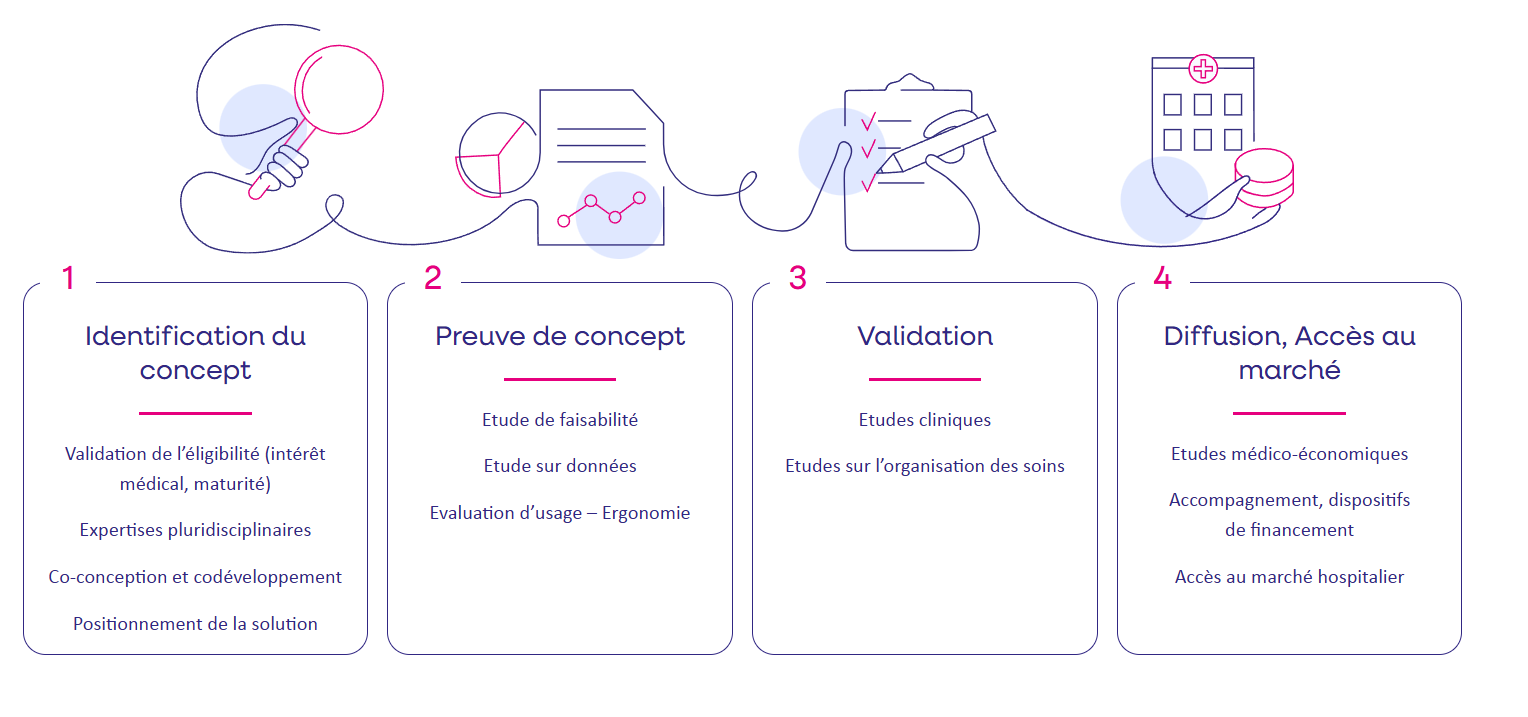
Station E-Santé is a Tiers-lieu experimental hub dedicated to digital health, bringing together healthcare organizations, multidisciplinary scientific expertise, technological and methodological expertise, and socio-economic entities.
The consortium is composed of several stakeholders from the Nouvelle-Aquitaine region, such as the Bordeaux University Hospital (consortium leader), the Côte Basque Hospital, the Charles Perrens Hospital, the UNITEC technology park, Aquitaine Science Transfert, CATIE, and the University of Bordeaux.
Station E-Santé is a regional, multidisciplinary Tiers-lieu dedicated to real-world testing of digital health solutions for prediction, prevention/diagnosis, and treatment—from concept to market launch—with a focus on local engagement and efficiency.
Station E-Santé leverages a range of expertise to support developers of digital health solutions:
- Identification of the technological concept: multidisciplinary expertise, co-design, co-development, validation of medical value, etc.;
- Proof of concept: feasibility studies, data analysis, usability/ergonomics evaluation, etc.;
- Validation: clinical studies, healthcare organization studies;
- Dissemination/market access: health economic analyses, support for specific funding, access to the hospital market.
The "Tiers lieu" Experimental Projects
Project 1: IAVASC
Solution Provider: Nuréa
Solution: The PRAEVAORTA software is a solution based on specific algorithms that enable the automatic analysis of defined arterial regions (diameters, lengths, and volumes) for the detection and monitoring of aortic aneurysms.
Need: Many patients with aortic aneurysms are not accurately detected. Furthermore, current tools do not allow for precise monitoring of treated aneurysms. To address this without increasing the time experts spend on interpretation, automated tools capable of assessing these complex criteria must be provided to clinicians.
e-Health Station’s Contribution: Research facilities in vascular surgery and radiology; scientific and clinical expertise; collection of clinical and imaging data; interpretation; and scientific publication.
Project 2: KID-CCARE
Solution Provider: VirtualiSurg
Solution: The KIDCCARE project aims to develop and evaluate a virtual reality simulator for managing crisis situations specific to pediatric anesthesia, designed for the initial and continuing education of physicians.
Need: The KIDCCARE project aims to co-develop and evaluate digital reality scenarios with residents and healthcare professionals while assessing the effectiveness of this learning method compared to traditional methods (high-fidelity simulation).
Station e-Santé’s Contribution: With the support of Station [e]-Santé, an evaluation of the performance and value of the simulators in complex simulated pediatric anesthesia cases will be conducted, involving anesthesia residents as well as anesthesiologists as part of their continuing education. Thanks to CATIE’s involvement, a robust methodology will also be implemented to evaluate the ergonomics and acceptability of the simulators, as well as the value of this learning method for trainees.
Project 3: SoQut Imaging
Solution Provider: SoQut-Imaging
Solution: SoQut-Imaging offers a groundbreaking method for the non-invasive early detection and monitoring of NAFLD (non-alcoholic fatty liver disease) using a liver MRI sequence.
Need: SoQut-Imaging needs access to frontline professionals to validate the solution’s relevance, while enabling the co-development of the solution leading to its pilot testing.
Station e-Santé’s Contribution: Station [e]-Santé is supporting SoQut in demonstrating the solution’s clinical added value; finalizing the development of a product that complies with regulatory and quality requirements; and obtaining the various certifications (CE, FDA) necessary for the commercialization of a medical device.
VirtualiSurg - KID-CCARE
Contact
Find all the information about healthcare in Nouvelle-Aquitaine on the regional page.